Tricyrtis latifolia
Maxim.
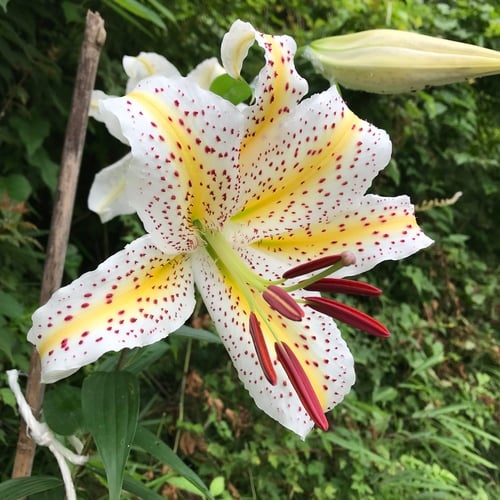
iNaturalist· cc-by-nc
(c) Keita Watanabe, some rights reserved (CC BY-NC), uploaded by Keita Watanabe
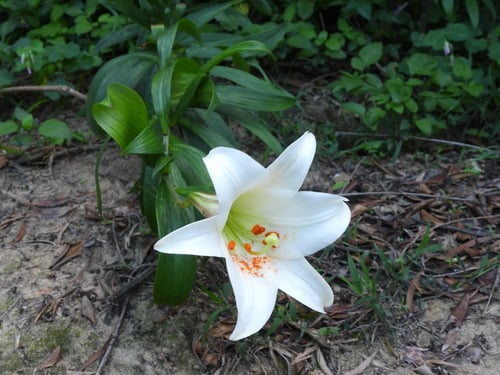
iNaturalist· cc-by-sa
(c) Douglas Goldman, some rights reserved (CC BY-SA), uploaded by Douglas Goldman
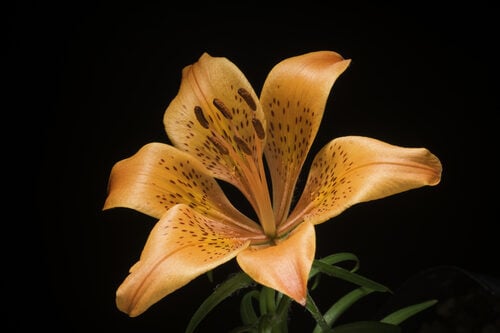
iNaturalist· cc-by-nc
(c) Samantha Leigh, some rights reserved (CC BY-NC), uploaded by Samantha Leigh
Summary
Source: WikipediaTricyrtis latifolia, the toad lily, is an East Asian species of plants in the lily family. As recognized by the World Checklist maintained by Kew Botanic Garden in London, T. latifolia is found only in Japan. Some authors maintain the some Chinese material also belongs to this species, but the World Checklist regards the Chinese populations as a distinct species, T. puberula. Further investigation seems warranted.
Description
A herb. The stem is 40-100 cm high. The leaves are oval and 1-1.5 cm long by 4-8 mm wide. The base is deeply heart shaped. The flowers are at the tip of the plant. There are many flowers in a group. The flowers are pale yellow with purple-red spots. The fruit is a capsule 3-3.5 cm across.
Edible Uses
Leaves and young shoots are edible when cooked.
Medicinal Uses
None known
Distribution
It is a temperate plant. It grows on the edges of forests in N China. in Sichuan.
Where It Grows
Asia, China, Japan,
Cultivation
Prefers a humus-rich fertile well-drained but moisture-retentive acid or neutral light sandy loam in partial shade. Prefers the dappled shade of a woodland garden but tolerates full sun if the soil is reliably moist throughout the growing season, flowering earlier in such a position. Plants require a sunnier position when growing in northern Britain. This species is hardy to about -20°c, but if prolonged cold weather is not accompanied by snow cover the plants will appreciate a good mulch of organic matter. Plants are very susceptible to attacks by slugs.
Propagation
Seed is best sown in a cold frame as soon as it is ripe. Stored seed requires 12 weeks of stratification at 5°C. Once large enough to handle, prick seedlings out into individual pots and grow on in the greenhouse for at least their first winter. Plant out into permanent positions in late spring or early summer, after the last expected frosts. Division can be done just before growth begins in spring, splitting to single crowns. Larger divisions can go directly into permanent positions; smaller divisions are best potted up and grown on in light shade in a greenhouse or cold frame until growing well, then planted out in summer or the following spring.
Other Uses
None known Special Uses
Notes
There are about 16 Tricyrtis species. Also put in the family Convallariaceae.
Synonyms
Also Known As
Kuan ye you dian cao
References (3)
- Bull. Acad. Imp. Sci. Saint-Petersbourg 11:435. 1867 (Diagn. pl. nov. jap.)
- Chen Xinqi, Liang Songyun, Xu Jiemei, Tamura M.N., Liliaceae. Flora of China. p 83
- Plants for a Future database, The Field, Penpol, Lostwithiel, Cornwall, PL22 0NG, UK. http://www.scs.leeds.ac.uk/pfaf/