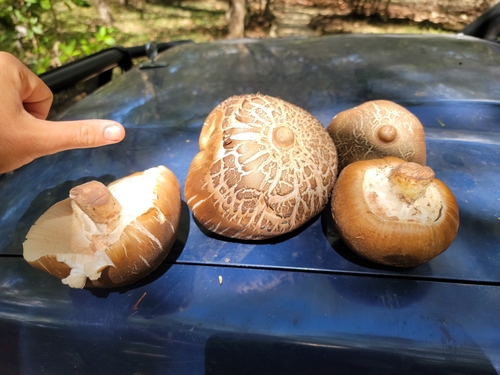
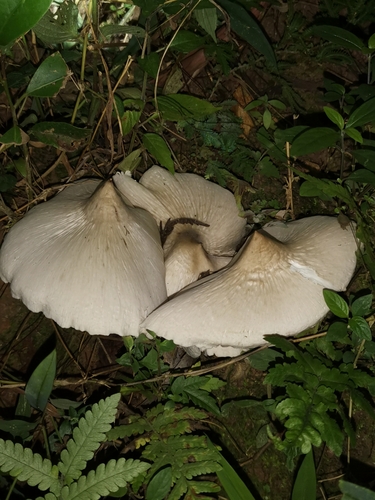
Termitomyces robustus
(Beeli) Heim
iNaturalist· cc-by-nc
(c) 大肚魚, some rights reserved (CC BY-NC), uploaded by 大肚魚
iNaturalist· cc-by-nc
(c) 大肚魚, some rights reserved (CC BY-NC)
Summary
Source: WikipediaTermitomyces robustus is a mushroom in the genus Termitomyces. Attempts at cultivation by humans have failed in past trials. As with all members of the genus Termitomyces, these fungi are cultivated exclusively by Termite species.
Description
A tropical mushroom in the Lyophyllaceae family that grows on termite mounds.
This description is brief — help expand it
Edible Uses
The mushroom is cooked with soup.
Traditional Uses
It is cooked with soup.
This uses section is brief — help expand it
Distribution
A tropical plant. It grows on termite mounds.
Where It Grows
Africa, Asia, Benin, Burundi, Cameroon, Central Africa, Central African Republic, CAR, Congo DR, Congo R, East Africa, Gabon, Ghana, Guinea, Guinée, Kenya, Malawi, Nepal, Nigeria, Rwanda, Sierra Leone, Tanzania, Togo, Uganda, West Africa,
Notes
Also put in the family Agaricaceae.
Nutrition
| Part | Moisture | kJ | kcal | Protein | Vit A | Vit C | Iron | Zinc |
|---|---|---|---|---|---|---|---|---|
| Mushroom | 8.3 | — | 382 | 14.8 | — | — | — | — |
Synonyms
Also Known As
Ero mkpu, Ewe, Ikizinu, Obuoch-ohumo
References (12)
- Adewusi, S. R. A. et al, 1993, Studies on some edible wild mushrooms from Nigeria: 1 Nutritional, teratogenic and toxic considerations. Plant Foods for Human Nutrition. 43:115-121.
- Aletor, V. A., 1995, Compositional studies on edible tropical species of mushrooms. Food Chemistry 54 (1995) 265-268
- Boa, E. R., 2004, Wild edible fungi and their importance to people. FAO Non Wood Forest Products Booklet 17
- Buyck, B., & Nzigidahera, B., 1995, Ethnomycological Notes from Western Burundi. Belg. Journ. Bot. 128(2): 131-138
- Degreef, J., et al, 2016, Wild edible mushrooms, a valuable resource for food security and rural development in Burundi and Rwanda. Biotechnol. Agron. Soc. Environ. 2016 20(4), 441-452
Show all 12 references Hide references
- efta-online.org, Edible Fungi of Tropical Africa, Jardin botanique Meise
- Johns, T., and Kokwaro, J.O., 1991, Food Plants of the Luo of Siayo District, Kenya. Economic Botany 45(1), pp 103-113
- Kamalebo, H. M., et al, 2018, Uses and importance of wild fungi: traditional knowledge from the Tshopo province in the Democratic Republic of the Congo. Journal of Ethnobiology and Ethnomedicine (2018) 14:13
- Kokwaro, J. O. and Johns. T., Luo Biological Dictionary. p 79
- Obadi, M., et al, 2014, Evaluation of the Chemical and Antioxidant Properties of Wild and Cultivated Mushrooms of Ghana. Molecules 2014, 19, 19532-19548
- Okigbo, R. N. & Nwatu, C.M., 2015, Ethnostudy and Usage of Edible and Medicinal Mushrooms in Some Parts of Anambra State, Nigeria. Natural Resources, 2015, 6, 79-89
- Tibuhwa, 2013, Wild Mushroom - an underutilized healthy food resource and income generator: experience from Tanzania rural areas. Journal of Ethnobiology and Ethnomedicine 9:49