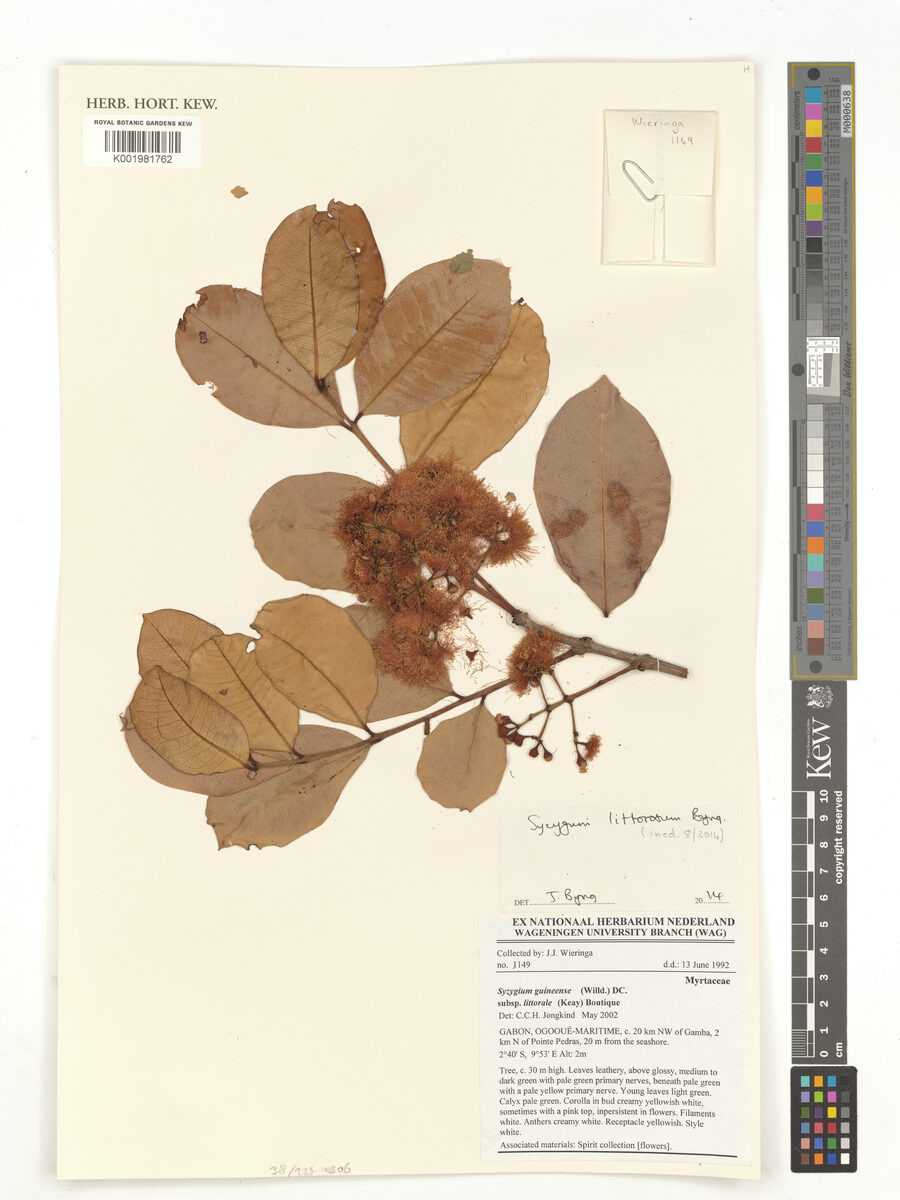
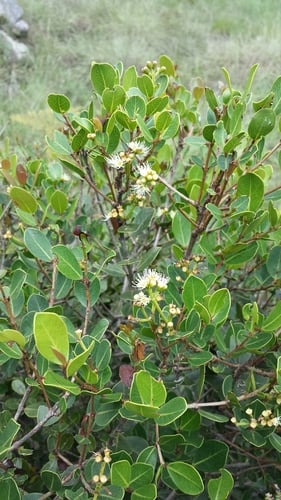
Syzygium suborbiculare
(Benth.) T. Hartley & Perry
Lady apple, Red bush apple
iNaturalist· cc-by-nc
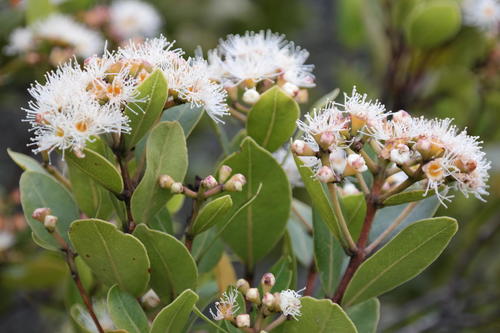
(c) Teghan Collingwood, some rights reserved (CC BY-NC)
iNaturalist· cc-by
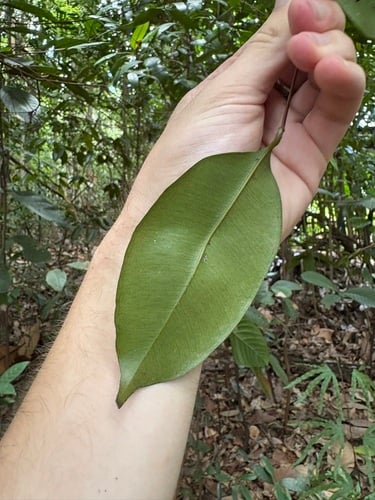
(c) Paul Asman and Jill Lenoble, some rights reserved (CC BY), uploaded by Paul Asman and Jill Lenoble
Summary
Source: WikipediaSyzygium suborbiculare, the red bush apple or lady apple, is a shrub or small understorey tree native to northern Australia and New Guinea.
Description
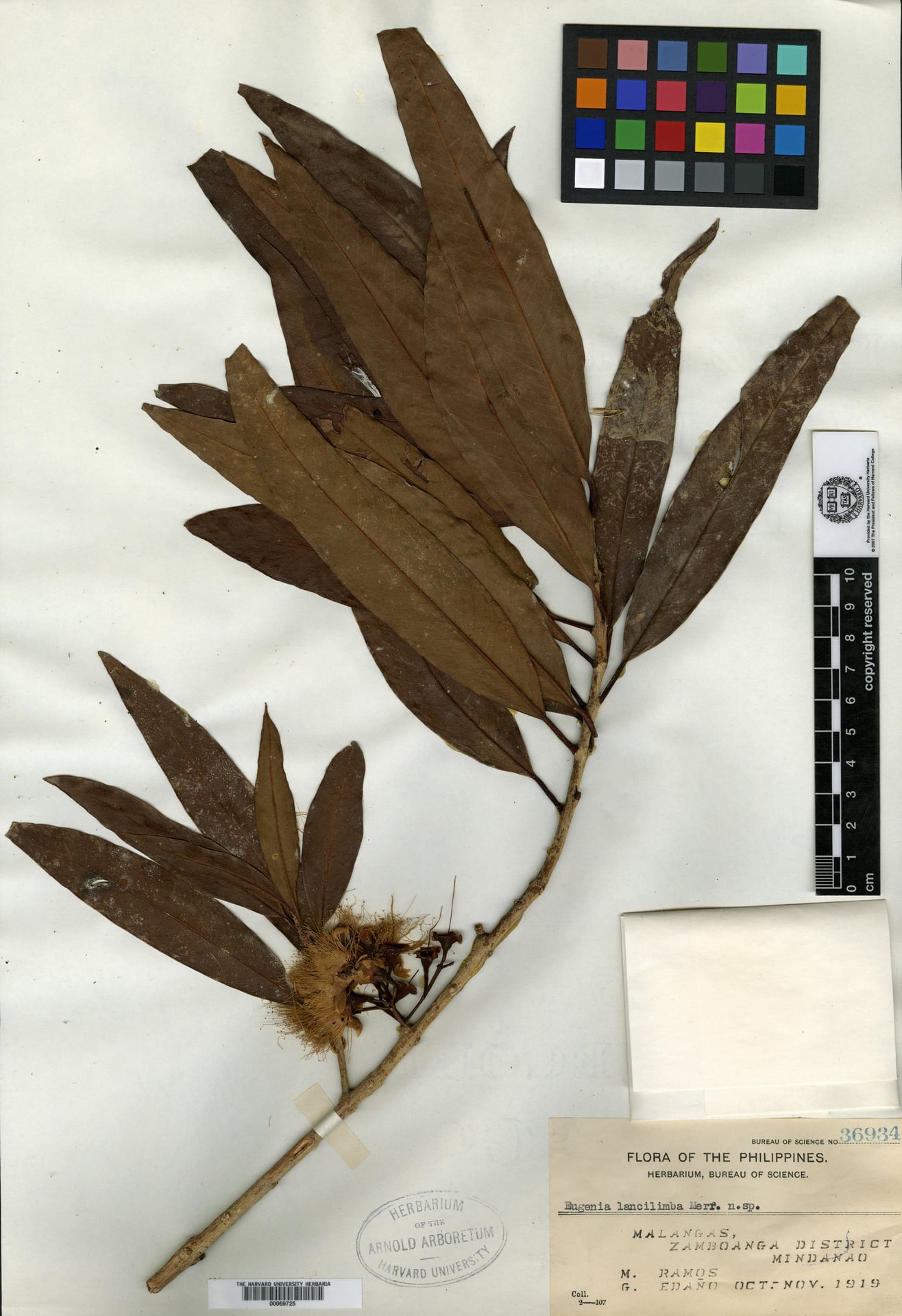
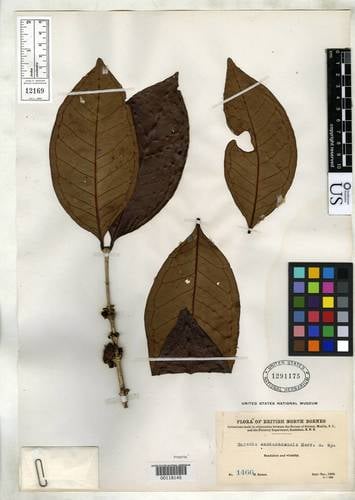
A tree. It grows 8-12 m tall. It has an upright form and a rounded crown. The bark is slightly rough, tightly attached and is grey-brown. The leaves are oval to roundish, opposite and smooth. They are 7-19 cm long by 4-13 cm wide. They are glossy and dark green on the upper surface and paler underneath. They have a short pointed tip. The flowers are large. They have numerous stamens. The flowers are 3-5 cm long by 2.5-3 cm wide and carried in dense clusters at the ends of branches. The fruit can occur either singly or in bunches. The fruit is round but flattened and fleshy. It is 3-7 cm long by 3.5-9 cm wide. It has distinct ribs and is red when ripe. The flesh around the seed is 1 cm thick. It is crunchy and bluish-pink in colour. It is edible. There is one large seed inside. The seed is about 3.5-5 cm across. It looks like a large apricot stone.
Edible Uses
The ripe fruit is eaten raw and can be used in cooking, sauces, and relishes. The fruit is high in vitamin C.
Traditional Uses
The ripe fruit are eaten raw. They can be used in cooking or for sauces and relishes.
This uses section is brief — help expand it
Medicinal Uses
The fruit is eaten raw by Aboriginal people. The tree is also used as firewood and as a nectar source for bees. The fruit has been regarded among the Aboriginal people as being particularly medicinally effective against respiratory problems. The juice extracted from the boiled or roasted fruit has been used to clear chest congestion or as a cough remedy; the fire-heated leaves were used to heal wounds; the pulp of a cooked fruit has been used to treat a sore ear; chewed fruit or seeds have been used as a remedy against toothache or mouth sores.
Distribution
It is a tropical tree. It occurs as an understorey tree to open forest. It also grows in rainforest. It occurs on well drained soils and sandy soils. It can tolerate fire because it produces a lignotuber under the ground. It can re-grow from this tuber. During drought it can lose most of its leaves. It tolerates salty winds.
Where It Grows
Asia, Australia*, Indonesia, Pacific, Papua New Guinea, PNG, SE Asia, Torres Strait,
Cultivation
It can be grown from fresh seed. Branches are low making harvesting easy. Fruit should be harvested when ripe before fruit fall.
Propagation
Seed - it has a short viability and needs to be sown when fresh. It germinates well and grows quickly.
Other Uses
Of no commercial value as a timber, the wood can be used as fuel. The tree can provide shade and shelter.
Production
Seedling growth can be rapid. Flowering occurs July to October in Australia and fruiting is October to February. It can produce fruit during any month but tends to fruit during the wet season. The quality of the fruit varies between trees.
Other Information
A popular food in northern Australia.
Notes
It has medicinal uses. The fruit is high in Vit C.
Nutrition
| Part | Moisture | kJ | kcal | Protein | Vit A | Vit C | Iron | Zinc |
|---|---|---|---|---|---|---|---|---|
| Fruit | 89.3 | 146 | 35 | 0.6 | — | 8 | 1.2 | 0.2 |
Synonyms
Also Known As
E-sie, Ilara, Kaway, Narrani, Oloorgo, Pinyawini, Pudginjacker, Purringawuni, Wurringawuni, Yinumaninga
References (39)
- Bindon, P., 1996, Useful Bush Plants. Western Australian Museum. p 241
- Bodkin, F., 1991, Encyclopedia Botanica. Cornstalk publishing, p 964
- Boland, D. J. et al, , 2006, Forest Trees of Australia. CSIRO p 631
- Brock, J., 1993, Native Plants of Northern Australia, Reed. p 294, 309
- Cherikoff V. & Isaacs, J., The Bush Food Handbook. How to gather, grow, process and cook Australian Wild Foods. Ti Tree Press, Australia p 201
Show all 39 references Hide references
- Cooper W & Cooper W T, 1994, Fruits of the Rain Forest. RD Press p 278
- Cooper, W. and Cooper, W., 2004, Fruits of the Australian Tropical Rainforest. Nokomis Editions, Victoria, Australia. p 368
- Doran, J.C., & Turnbull, J.W. (Eds), 1997, Australian Trees and Shrubs: species for land rehabilitation and farm plantings in the tropics. ACIAR Monograph No 24. p 338
- Fell, D.G. & Stanton, D.J., 2015: The vegetation and flora of Mabuyag, Torres Strait, Queensland. Memoirs of the Queensland Museum – Culture 8(1):1-33. Brisbane. ISSN 1440-4788.
- Hardwick, G., 2001, Economically Useful Plants for Northern Australia: Master Species List. Crusader eBooks.
- Hartley, T. G. & Perry, L. M., 1973, Syzygium (Myrtaceae) from Papuasia J. Arn. Arb. Vol 54 p 196
- Hearne, D.A., & Rance, S.J., 1975, Trees for Darwin and Northern Australia. AGPS, Canberra p 66, Pl 16
- Hedrick, U.P., 1919, (Ed.), Sturtevant's edible plants of the world. p 302 (As Eugenia suborbicularis)
- Hibbert, M., 2002, The Aussie Plant Finder 2002, Florilegium. p 296
- Hiddins, L., 1999, Explore Wild Australia with the Bush Tucker Man. Penguin Books/ABC Books. p 148
- INFOODS:FAO/INFOODS Databases
- Isaacs, J., 1987, Bush Food, Aboriginal Food and Herbal Medicine. Weldons. p 72
- Kiple, K.F. & Ornelas, K.C., (eds), 2000, The Cambridge World History of Food. CUP p 1798
- Lazarides, M. & Hince, B., 1993, Handbook of Economic Plants of Australia, CSIRO. p 233
- Levitt, D., 1981, Plants and people. Aboriginal uses of plants on Groote Eylandt. Australian Institute of Aboriginal Studies, Canberra. p 110
- Low, T., 1991, Wild Food Plants of Australia. Australian Nature FieldGuide, Angus & Robertson. p 148
- Low, T., 1992, Bush Tucker. Australia’s Wild Food Harvest. Angus & Robertson. p 55
- Mua Bioversity Profile, 2013, Profile for Management of the Habitats and Related Ecological and Cultural Resources of Mua Island. Torres Strait Regional Authority Land & Sea Management Unit. p 32
- Norrington, L., & Campbell, C., 2001, Tropical Food Gardens. Bloomings Books. p 89
- Paczkowska, G . & Chapman, A.R., 2000, The Western Australian Flora. A Descriptive Calatogue. Western Australian Herbarium. p 403
- Robins, J., 1996, Wild Lime. Cooking from the Bush food garden. Allen & Unwin p 55
- Scarth-Johnson, V., 2000, National Treasures. Flowering Plants of Cooktown and Northern Australia. Vera Scarth-Johnson Gallery Association. Cooktown, Australia. p 123
- Smith, M & Kalotas, A. C., 1985, Bardi Plants: An Annotated List of Plants and Their Use by the Bardi Aborigines of Dampierland, in North-western Australia. Rec. West Aust. Mus. 1985, 12(3): 317-359
- Smith, N and Wightman, G.M., 1990, Ethnobotanical Notes from Belyuen Northern Territory Australia. Northern Territory Botanical Bulletin No 10. Parks and Wildlife Commission of the Northern Territory. p 25, 24.
- Smith, N. M., 1991, Ethnobotanical Field Notes from the Northern Territory, Australia, J. Adelaide Bot. Gard. 14(1): 1-65
- Tiwi Plants and Animals. 2001, Aboriginal flora and fauna knowledge from Bathurst and Melville Islands, northern Australia. Northern Territory Botanical Bulletin; No. 24 p 83
- Townsend, K., 1994, Across the Top. Gardening with Australian Plants in the tropics. Society for Growing Australian Plants, Townsville Branch Inc. p 350
- Vigilante, T., et al, 2013, Island country: Aboriginal connections, values and knowledge of the Western Kimberley islands in the context of an island biological survey. Records of the Western Australian Museum Supplement 81: 145-182
- Wheeler, J.R.(ed.), 1992, Flora of the Kimberley Region. CALM, Western Australian Herbarium, p 543
- Wightman, G. & Andrews, M., 1991, Bush Tucker Identikit. Common Native Food Plants of Australia’s top end. Conservation Commission Northern Territory. p 28
- Wightman, Glenn et al. 1992, Mangarrayi Ethnobotany: Aboriginal Plant Use from the Elsey Area Northern Australia. Northern Territory Botanical Bulletin No 15. Parks and Wildlife Commission of the Northern Territory. p 44, 43.
- Williams, K.A.W., 1999, Native Plants of Queensland Volume 4. Keith A.W. Williams North Ipswich, Australia. p 364
- World Checklist of Useful Plant Species 2020. Royal Botanic Gardens, Kew
- Yunupinu Banjgul, Laklak Yunupinu-Marika, et al. 1995, Rirratjinu Ethnobotany: Aboriginal Plant Use from Yirrkala, Arnhem Land, Australia. Northern Territory Botanical Bulletin No 21. Parks and Wildlife Commission of the Northern Territory. p 72.